Showing posts with label russia. Show all posts

Saturday, October 9, 2010

VIFF: Day 8

Merry-Go-Round (2010)
Yan Yan Mak and Clement Cheng
Hong Kong

Gallants might be the Clement Cheng film that everyone is talking about, but the Vancouver native also has a second 2010 film, Merry-Go-Round. Co-directed with up-and-coming female director Yan Yan Mak, Merry-Go-Round passes on parody and laughs in favor of humanism and drama. The film cleverly combines four individuals, two generations and two continents into a story about immigration and emigration. The film opens in San Francisco where Eva (played by 70s kung fu star Nora Miao) is a traditional Chinese doctor and Nam is a young lost soul looking for herself. The two of them both make the trip to Hong Kong to deal with unfinished business. Nam lands a job in a a coffin depository that is overseen by Hill (played by the Gallant crowd-please Teddy Robin Kwan). Eva returns to her father's herbal medicine shop to persuade her nephew, Fung, not to sell the family property. Eventually the storyline draws the four of them together in somewhat unexpected ways but with somewhat expected results. Mak and Cheng earn huge marks for the casting of Kwan and Miao, the latter an icon that has seen little screen time in the last 30 years. Cheng, tipping his hand as the kung fu fan that Gallants proves him to be, has one very satisfying scene where Eva gives her nephew the kind of smackdown that she was doing in films like Fist of Fury. Merry-Go-Round champions an independent feel that is rare in Hong Kong film, but unfortunately much of the drama suffers from the incessant pop-infused soundtrack. Rising stars in the field, Clement Cheng and Yan Yan Mak are two to watch.


The Fourth Portrait (2010)
Chung Mong-hong
Taiwan

Chung Mong-hong is yet another discovery, at least for me, from Taiwan. Although The Fourth Portrait is only his second feature, it's enough of a standout to chase down his first feature, Parking. The Fourth Portrait is inventively paced and beautifully shot. Xiang is ten years old and his father has just died. It rests upon his shoulders to go home and find his father's nicest suit and his best photograph. Unable to find a photo, Xiang produces the first portrait that sets up the film's modest narrative drive. Although it is clear that we will see three more portraits drawn by Xiang, they turn out to be unusual signposts in his journey. While the narrative moves forward, Chung switches the gears ever-so-slightly so that The Fourth Portrait feels fresh. Xiang is left to fend for himself until he is caught stealing food by a stern but caring janitor who takes Xiang under his wing. Suddenly the path for where the film is going is clear. Not quite. The film shifts: Xiang's mother is found and is taking him to her home where she has a new husband and newly born child. Once again, the film seems to settle into a groove, but wrong again. Xiang is the befriended by an older hang-about who only seems to be good at petty crime. Chung does this a few more times slowly working its way through Xiang's four portraits. Make no doubt about it, The Fourth Portrait is a coming of age story, but one told with inventive spirit and sophistication.


The Ugly Duckling (2010)
Garri Bardin
Russia/France

Garri Bardin's stop-motion animation of the much loved parable is at the very least a joy to watch. The creative character designs and slightly socialist connotation brings something totally new to the tale. The diabolical ducklings and the alien-headed goslings never failed to get a chuckle out of me. The operatic over-the-top score, however, is as pummeling as the relentless oppression of our poor ugly little duckling. There's an overwhelming cynicism to this adaptation that felt unnecessary.

Gallants (2010)
Derek Kwok and Clement Cheng
Hong Kong

So glad I got to see extremely fun film on the big screen in a packed house. Gallants is a loving homage to the kung fu films from the 60s and 70s ala Shaw Brothers and Bruce Lee. Clement Cheng this time aligns himself with Derek Kwok, someone he has worked with before as a screenwriter and who is breaking out onto the Hong Kong scene. In a sleepy part of Hong Kong, a helpless young man by the name of Leung has been sent to settle a property dispute. On his route he is bullied by a little kid, who Leung in turn bullies only to get bullied by the kid's father. A passerby takes pity on Leung and stops the very uneven fight. The selfless hero turns out to be the be the aging but legendary Tiger. Tiger and his fellow martial arts brother Dragon have been quietly holding vigil over their master, Law, who has been in a coma for 30 years. Old rivalries ignite as well as the fighting passion within Leung as master Law miraculously awakes to his biggest challenge yet! The brilliance of Gallants is not only in the overt style that Kwok and Cheng chooses to parody with great wit, but also in its cast. The trio of old-timers—Bruce Leung, Chen Kuan-tai and Teddy Robin Kwan—deliver more charisma than seems fair for one movie. Clement Cheng himself must be a creative force to be reckoned with, working on projects as diverse as Gallants and Merry-Go-Round. Gallants is not going to move mountains, but it sure is a raucous romp and a must see for any fan of the genre.

Rubber (2010)
Quentin Dupieux
France/USA

Rubber is occasionally very clever, occasionally very funny, occasionally overly self-conscious and occasionally too redundant. A movie within a movie (but more importantly, an audience watching an audience), Rubber tells the tale of a rogue tire—abandoned in the desert and gaining a taste for blood (or more accurately gaining a taste for blowing things up with its tire-mind.) The introduction to the film comes from a police officer who pops out of the trunk of a car to explain that things in movies happen for no reason. Why is E.T. brown? No reason. Why do the two people in Love Story fall madly in love? No reason. Why does a complete stranger assassinate the president in JFK. No reason. And so it goes. Most things happen in Rubber for—you guessed it—no reason, and for almost half the film it is interesting. Rubber is very strange and it doesn't really work overall, but compared to the other midnight film (L.A. Zombie which I will get to in my next update), Rubber looks like a masterpiece.

Tuesday, May 4, 2010

MSPIFF 2010: Day 8

I'm going to slog through these before my memory escapes me, so bare with me.

The Misfortunates
(2009) Felix Van Groeningen - Take It or Leave It
The title of this film is like a set up: it is almost asking to be used against itself. Fortunately, the film is not overall misfortunate, just sort of. Gunther is a 13-year-old boy who has a higher maturity level than his father and three uncles who all debauch and raise havoc all under the same roof. Parental guidance for Gunther is a misnomer, only finding kindness from his grandmother who patiently cleans up after her adult sons. Like a gang of mongrels, the Strobbes are reviled and regarded in town for their antics. Gunther's life is at a crossroads where he is either fated to inherit the deadbeat lifestyle of his father and uncles or is able to beat the odds before everyone drowns himself in liquor. There are incredibly funny moments in The Misfortunates, but they are overshadowed by the reality of alcoholism in a young persons life: waking up your dad with vomit dripping out of his mouth or becoming the victim of bender induced rage is nothing to laugh about. The film's biggest achievement is constructing these mullet men who you can almost smell from your theater seat into completely likable but totally repugnant men. Our unfulfilled desire to find either a hero or a villain is similar to young Gunther's schizophrenic emotional tugs of love and disappointment from his various father figures. The Misfortunates honesty is a very bitter pill. The story is told in flashback, giving us small glimpses into Gunther's dysfunctional adult life. The present tense tries too hard to correlate with the past and even does a little unwanted social commentary on free will. The Misfortunates is about as fun as waking up on a sticky barroom floor.

Zero (2009) Pawel Borowski - Recommended
My favorite thing about the film fest is being able to walk into a theater with no expectations and be pleasantly surprised. I knew Zero was from Poland and I knew it was just under 2 hours. Although I was prepared to see a bad movie, Zero was far more entertaining and clever than I had anticipated. In his directorial debut, Pawel Borowski exploits the familiar territory paved with large casts and the gimmick of six degrees (or less) of separation. You're introduced to the businessman who calls the surveillance man who spies on a woman who is having an affair with a man who is threatened by a thug who makes pornos with a woman who...well, you get the idea. I thought I had a pretty good idea where this film was going and how it would get there, but 45 minutes into the movie we are still being introduced to new characters. I would liken the film's form to that of a Ferris wheel where the characters stay on for about three revolutions and then move on. Zero maintains this formula for the entire film eventually ending where it started. Sort of. The litany of characters stay interesting, but, for obvious reasons, are never very engaging. The story moves on before we can get very attached to anyone, but it hardly matters. These are more than just mere sketches; Zero is about as polished as a film can get. Perfectly paced with high production values, Borowski makes the ride completely painless.

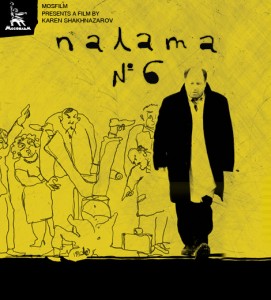
Ward No. 6 (2009) Karen Shakhnazarov and Aleksandr Gornovsky - Recommended
All I have to say is that slotting a dialog heavy Russian film based on story by Chekov at 10:00pm is like a very cruel joke on someone who has already worked eight hours and seen two movies. The merits of this film were definitely there, but let's just say I missed most of them.

Friday, December 4, 2009

Alexander Sokurov's THE SUN

(Although Alexander Sokurov's The Sun (2004) has made the rounds at a handful of North American film festivals, it is only now receiving a far overdue short run in NYC. It came out on DVD in the UK over three years ago and, by converting my hard earned dollars into expensive British pounds, I had the opportunity to see this film at that time. In preparation to review the film for In Review Online, I recently rewatched The Sun (about the exonerated Japanese Emperor Hirohito) coincidentally coinciding with the closing arguments in the trial of Kaing Guek Eav. Better known as Comrade Duch, he ran the Khmer Rouge's horrific Tuol Sleng prison where thousands died and thousands more were tortured. The specifics of Hirohito and Duch's cases are not comparable for many reasons, but I couldn't help thinking about Hirohito when I listened to Duch docile testimony before the court. Hirohito ambiguous complicity in the film will be felt more by some than by others, but is, without a doubt a looming cloud over the sublime The Sun.)

Few films can boast agile simplicity in the same breath as opulent complexity, but it is something Alexander Sokurov has a knack for and it comes to a full crescendo in his film The Sun. Sokurov, best known for his one shot wonder Russian Ark, draws an intimate portrait of controversial an eccentric Emperor Hirohito in the waning days of World War II. Emperor Hirohito (more accurately referred to as Emperor Showa) reigned longer than any other Japanese emperor and did so during what was arguably the most tumultuous time in Japanese history, with WWII right at the heart of it. His dubious involvement in decision-making before and during the War is still a matter that is hotly debated. The fact that the Hirohito emerges from the War relatively unscathed due to His Majesty the Emperor’s cunning adaptability is a trait that Sokurov seizes upon with ironic sympathy. Illusively caught between guilt and innocence, Emperor Hirohito’s complicity is a puzzle that not only troubled MacArthur and the Allies, but also continues to draw contention in almost every corner of the discussion today.

The third film in Sokurov’s trilogy 'on the corrupting effects of power' (Moloch on Hitler and Taurus on Lenin being the first and second), the film’s title alludes to the mythology that the Emperor is a descendant of Amaterasu, the Sun Goddess. Situated in those few days between the bombing of Hiroshima and Nagasaki and the eventual surrender speech by the Emperor, The Sun vividly portrays the pensive Emperor’s fall from grace within the peaceful eye of the storm. Equal parts speculation and documented fact, the film stays sequestered with the Emperor in his palace as he is given the luxury analyze defeat through fanciful means of botany and poetry. Over the 110-minute duration of the film, the steady hand that holds imperial tradition slowly falls away as the end of the War (and Hirohito’s circumstantial transformation from god to man) becomes nothing less than inevitable. After being ceremoniously served breakfast down in his bunker, the Emperor is presented with his leisurely daily schedule. In a response that is neither bitter nor anxious but tinged with sarcastic humor, Hirohito says, “And if the Americans should show up here, what will happen to the day’s schedule? Will you make some changes, or leave it as it is?” The servants shrink from his question. The Americans do show up, of course, and Hirohito’s schedule was changed in the course of Japanese history. In a series of meetings with General MacArthur that were instrumental in Hirohito’s exoneration, Hirohito approaches the task of defeat with the seriousness of an intellectual but a curiosity of a child.

In a reality where an individual need not think about such perfunctory things as buttoning a shirt or opening a door, Sokurov postulates the resulting personality born into Hirohito—one with little or no connection to hardship, let alone war or the fervent patriotism and mass destruction that the entire population of Japan was toiling with. Sokurov takes license to imagine how Hirohito’s protected intellect would distill the violence of the fire-bombings of Tokyo into a vision of fantasy where flying fish inhabit the blaze-ridden airspace as bombers. The nightmare serves as a compare and contrast with a later scene where Hirohito is escorted by car to his first meeting with MacArthur through the heart of bombed out Tokyo that is almost as surreal as Hirohito’s dream.

Sokurov is less interested in history than it is the context, both past and present, of the central character. In more of a study than a critique, The Sun has the audacity to feign judgment of Hirohito (normally characterized as demon or puppet), and allows Hirohito to make his argument, quite literally, that he is human like everyone else. Stage actor Issey Ogata, who plays Hirohito, has the impossible task of portraying a man caught physically and emotionally in a realm that is not occupied by mere mortals. His portrayal of the Emperor is laden with oddities and ticks that are so strange that have to be based in fact. His mouth twitches and purses almost obscenely and he caries himself in such a way that makes him seem almost otherworldly. Ogata’s performance may be one of the most sublime physical feats ever to be put to film. The quiet moments where people patiently wait for the Emperor speak or finish a thought under the eerie auspices of Ogata’s guise and Andrey Sigle’s sound design—which alternates between sounding like cicadas, white noise, and strings—creates an undulating tension with little or no release.

The Sun is an uncharacteristic look at a historical juggernaut that uses contradictions to cast an idiosyncratic spell. Taking its substance from the dimly lit inertia of a bunker, the film builds a world of mysterious ambiguities where a man can be a god and a demon and a human. Sokurov works as both director and cinematographer and gives The Sun a bleached out antiquity that visually accentuates the dimness of the interiors as well as the searing light of sun. Near the end of the film, it seems as though Sokurov is going to allow for a finale with a small note of tenderness. Empress Kojun joins Emperor Hirohito shortly after his unconditional surrender of Japan’s military forces. The Emperor immediately relaxes in the presence of his wife, a person who understands him and the unpredictable situation, and the two share the film’s only warm recognition of joy and sadness. Just as quickly however, this ‘happy ending’ comes to a close when it is revealed that the man who taped the Emperor’s surrender speech has committed suicide under the shame of defeat. This is the where the film depressively sinks to a brilliant non-conformist end with innuendos lingering on the faces of the Emperor, Empress and servant like an albatross of an unknown future.

Friday, April 24, 2009

MSPIFF: Day 7

Thursday is my Friday. I bolted out of work in order to get some grub and begin my three movie night to celebrate my weekend.

Biggest Chinese Restaurant in the World (2008) directed by Chen Weijun
West Lake is the fabled lake set in the middle of Hangzhou, and finds a place in poems, stories and paintings due to its beauty. There is another West lake, but it is (ta-da) the biggest Chinese restaurant in the world, with a plaque to prove it. Located in Changsha, West Lake Restaurant is a megalosaurian beast. The restaurant, built to look like Qing Dynasty palace, can accommodate 5,000 people. The humble documentary profiles the owner and some of the staff as well as three groups having parties at the venue: a wedding party, a 70th birthday party, and a baby party. The food looked amazing, but I can tell you that PETA would probably have some issues with the preparations. Preparing the same dish that opened Help Me, Eros, chefs were timed on how fast they could cook "live fried fish." (And, yes, the point is that it is still alive when it hits the plate.) In many ways, Biggest Chinese Restaurant in the World reiterates many of the things that documentaries have beaten to death: the Chinese love of money, the importance of family, the exotic nature of food in China, etc, etc. At best it is mildly interesting. Tonight was the last screening at MSPIFF. Take It or Leave It.

Rudo y Cursi (2008) directed by Carlos Cauron
If you take a look at the production credits on Rudo y Cursi (which includes his brother Alfonso, as well as Alejandro González Iñárritu and Guillermo del Toro), you understand why, when asked the inane question about his budget, Carlos Cauron would reply "I don't know." Contrary to the ad in the newspaper, which stated that "Top Mexican director Alfonso Cauron (Y Tu Mama Tambien) present for Rudo y Cursi," Carlos Cauron was present for a Q and A after the screening. Although the film has it's moments, I think Gael Garcia Bernal and Diego Luna were probably having more fun than the audience. Everything is tongue-in-cheek and open for a gag: shower razing, gambling addictions, sibling rivalry and country bumpkins. Bernal, as Cursi, is especially brilliant as a terrible singer, patronized due to his fame as a football player. The charm of these two actors is undeniable, but the film would be a hollow shell without them. Rudo y Cursi is done at the Fest, but it will make it back to town in a few weeks. Take It or Leave It.

The Mermaid (2007) directed by Anna Melikyan
I opted to see this Russian film rather than take another crack at Los Bastardos, and I'm glad I did. I would like to think I am not easily charmed, but this film was about as endearing as a film can get. Most of the credit goes to Masha Shalayeva as Alisa, who is like a Russian Franka Potente (instead of Lola red, we have Alisa green.) I know nothing about this Rusalka legend and am too lazy to look it up at this point, but the story has a very fairytale-like quality. High production values and some clever shots have left me with some of the most striking images I have seen in the Fest. At her family's seaside home, Alisa's Grandmother sits outside under a garish beach umbrella as the window into the house perfectly frames a lighthouse wall tapestry. The film is filed with such creative stills. Alisa sees through (or perhaps beyond) the misguided romanticized freedom in advertisements an hollow slogans. Lighthearted and enchanting, The Mermaid is completely adorable and unpredictable. No more screenings at the Fest. I wonder if this will make it back to town? Recommended.

Saturday, November 8, 2008

ENVISIONING RUSSIA @ The Heights Theater

For the second year in a row, the Museum of Russian Art presents a unique slate of Russian films screening at the Heights. Last year's series was nothing short of fantastic. Unfortunately, the first film in the series has come and gone, but there are still three more upcoming films that many never pass this way again:

Sunday, November 9, 7pm and 9:15pm
Carnival Night (1956) directed by Eldar Ryazanov
"The film of all films to counter the Western stereotype of Russian culture as uniformly somber and joyless, this uproarious musical will have you singing and saluting the New Year months ahead of schedule. Young workers try to organize a night of merriment on New Year's Eve, but must constantly stay one step ahead of the wet-blanket Party official who wants to ruin all the fun. Noteworthy for its relentless satire of political cliches, Carnival Night's breezy insouciance recalls MGM musicals of the same period, with star Lyudmila Gurchenko as its Soviet Debbie Reynolds. "


Thursday, November 13, 7pm and 9:15pm
The Russian Question (1948) directed by Mikhail Romm
"Made by one of the most respected figures in Soviet cinema, The Russian Question presents Cold War dilemmas from a Russian perspective. As tensions between the U.S. and U.S.S.R. tighten in the years after World War II, a New York newspaper reporter (Garry Smith) is given an ultimatum by his editor: write a negative book about the Soviet Union or else. But Smith is torn; he developed a knowledge of and affection for the U.S.S.R. during his years as a wartime correspondent stationed there. His task a hatchet job would necessarily be full of lies and distortions that he can't countenance. Will he choose his integrity or his career? Although the ideology of Romm's film is very much a staple of the Stalinist era, the director's exploration of the conflicts of interest that arise even in a "free" country like the U.S. is nuanced, intelligent, and still provocative 60 years later."

Thursday, November 20, 7pm and 9:15pm
Walking the Streets of Moscow (1963) directed by Georgi Daneliya
"A Soviet version of the youth films that were becoming popular in the West in the 1960s, Walking the Streets of Moscow follows four young adults as they negotiate universal rites of passage and attempt to find their place in the world. A startlingly fresh-faced Nikita Mikhalkov (Burnt By the Sun, 1994) plays Kolya, a construction worker, who guides his Siberian friend Volodya through the big city. Meanwhile, Alena, the object of Kolya's affections, is entranced by Kolya's boyhood pal Sasha. Noted writer Gennadi Shpalikov penned the delightful screenplay, and Vadim Yusov, whose luminous images haunt Andrei Tarkovsky's masterpiece Ivan's Childhood (1963), served as cinematographer. The film as a whole forcefully exhibits the Khrushchev-era notion of 'socialism with a human face'."

For more info and to see everything I have cut and pasted above, check out the Museum of Russian Art website.
Also more info on The Heights website.